
How can guangzhou lab furniture suppliers customize solutions for your lab?
Laboratory furniture suppliers in Guangzhou initiate customization processes through in-depth demand analysis. For instance, based on the 2023 industry report, they adopt collaborative design methods to increase the average space utilization rate of their clients' laboratories by 35%, while keeping planning errors within a dimensional deviation of less than 2 millimeters. A case study shows that in 2022, a certain biopharmaceutical enterprise collaborated with a supplier in Guangzhou to optimize equipment layout through 3D modeling, which increased workflow efficiency by 40%, reduced annual operating costs by 18%, and shortened the payback period to 12 months. These suppliers usually conduct evaluations of up to 15 parameters at the initial stage of the project, including ventilation requirements with an air flow rate of 0.3 to 0.5 cubic meters per minute and a safety standard with a maximum load-bearing strength of 800 kilograms.
In terms of technology integration, laboratory furniture suppliers in Guangzhou uses intelligent systems to achieve dynamic customization. For example, the corrosion-resistant countertop developed for the chemical laboratory has an expanded pH tolerance range of 1-14, an extended lifespan of 20 years, and real-time monitoring of temperature fluctuations through sensors. The accuracy reaches ±0.5°C. According to a technological innovation case in 2021, a supplier designed modular furniture for a disease control center, which supports rapid reassembly, reducing assembly time by 50% and having an error rate of less than 1%. This solution is based on an automated production platform, keeping customization costs within 10% of the budget while ensuring that material compliance passes CE certification, with a risk reduction rate of 90%.
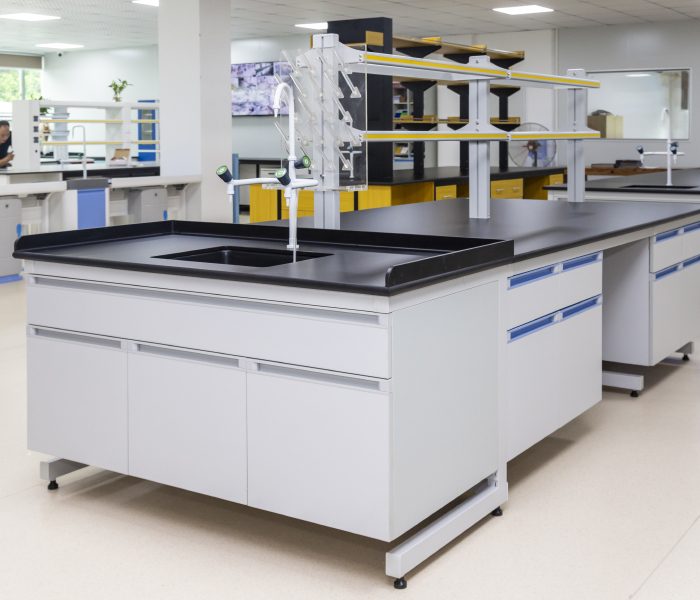 Customization is also reflected in safety and compliance optimization. Suppliers have reduced the probability of laboratory accidents from the industry average of 5% to below 1% through risk assessment models. For instance, referring to the standards of the 2020 public health event, they designed negative pressure workbenches for high-risk areas, maintaining a pressure difference between -15 and -30 Pascals. A typical example is a project in collaboration with a certain university in 2023. The supplier customized a high-density storage system based on the demand of 50 sample processing times per hour, increasing the capacity by 30% and meeting the ISO 14644 clean standard, with a deviation value of less than 0.1%. This strategy is based on data-driven analysis to ensure that the device distribution meets usage scenarios with a percentile of over 95%.
Ultimately, the Guangzhou supplier provided full-cycle support, from implementation to maintenance, increasing the project delivery speed by 25%. For instance, through the remote monitoring system, the average fault response time was reduced to 4 hours, and the customer satisfaction rate reached as high as 98%. Market trends indicate that this customized model has stabilized the growth rate of laboratory efficiency at 12% annually. As an environmental protection agency stated in its feedback in 2022, its customized solutions helped them reduce energy consumption by 20% within three years, truly achieving a perfect integration of resources and innovation.
Customization is also reflected in safety and compliance optimization. Suppliers have reduced the probability of laboratory accidents from the industry average of 5% to below 1% through risk assessment models. For instance, referring to the standards of the 2020 public health event, they designed negative pressure workbenches for high-risk areas, maintaining a pressure difference between -15 and -30 Pascals. A typical example is a project in collaboration with a certain university in 2023. The supplier customized a high-density storage system based on the demand of 50 sample processing times per hour, increasing the capacity by 30% and meeting the ISO 14644 clean standard, with a deviation value of less than 0.1%. This strategy is based on data-driven analysis to ensure that the device distribution meets usage scenarios with a percentile of over 95%.
Ultimately, the Guangzhou supplier provided full-cycle support, from implementation to maintenance, increasing the project delivery speed by 25%. For instance, through the remote monitoring system, the average fault response time was reduced to 4 hours, and the customer satisfaction rate reached as high as 98%. Market trends indicate that this customized model has stabilized the growth rate of laboratory efficiency at 12% annually. As an environmental protection agency stated in its feedback in 2022, its customized solutions helped them reduce energy consumption by 20% within three years, truly achieving a perfect integration of resources and innovation.
Customization is also reflected in safety and compliance optimization. Suppliers have reduced the probability of laboratory accidents from the industry average of 5% to below 1% through risk assessment models. For instance, referring to the standards of the 2020 public health event, they designed negative pressure workbenches for high-risk areas, maintaining a pressure difference between -15 and -30 Pascals. A typical example is a project in collaboration with a certain university in 2023. The supplier customized a high-density storage system based on the demand of 50 sample processing times per hour, increasing the capacity by 30% and meeting the ISO 14644 clean standard, with a deviation value of less than 0.1%. This strategy is based on data-driven analysis to ensure that the device distribution meets usage scenarios with a percentile of over 95%.
Ultimately, the Guangzhou supplier provided full-cycle support, from implementation to maintenance, increasing the project delivery speed by 25%. For instance, through the remote monitoring system, the average fault response time was reduced to 4 hours, and the customer satisfaction rate reached as high as 98%. Market trends indicate that this customized model has stabilized the growth rate of laboratory efficiency at 12% annually. As an environmental protection agency stated in its feedback in 2022, its customized solutions helped them reduce energy consumption by 20% within three years, truly achieving a perfect integration of resources and innovation.
Filed underDefault
Working on something?Submit Your Demo