
How Does ADSS Suspension Clamp Improve Fiber Cable Stability?
In the field of optical fiber communication, the ADSS suspension fixture has significantly enhanced the stability of optical fiber cables through its innovative structural design. For instance, it can withstand a static load of up to 25 kilonwtons, reducing the cable's swing amplitude to less than 5 centimeters in extreme weather conditions with wind speeds of 40 meters per second. Compared with traditional fixtures, this design reduces the probability of failure by over 60%. According to the actual application of the State Grid in a provincial backbone network upgrade project in 2021, after adopting the ADSS suspension fixture, the service life of the cable was extended from an average of 20 years to 30 years, and the maintenance cost decreased by 30%. This is attributed to the high tensile strength of its all-dielectric material (usually exceeding 1000 megapascals) and excellent corrosion resistance. Industry research shows that this type of fixture controls the peak stress of cables within a safe range by optimizing the tension distribution, thereby avoiding interruptions caused by fatigue fractures. For instance, during a typhoon event, the network in a coastal city, after using the ADSS suspension fixture, reduced the interruption time from an average of 10 hours to less than 2 hours, demonstrating its outstanding reliability.
From the perspective of materials science, the ADSS suspension fixture is made of high-strength polymer composite materials. Its weight is only 50% of that of traditional metal fixtures, but its compressive strength reaches 150 megapascals. It can maintain stable performance within the temperature range of -40°C to 80°C, and its coefficient of expansion under humidity changes is less than 0.1%. This ensures that the attenuation rate of the optical fiber cable is less than 0.2 dB/km during long-term operation. Taking a deployment by Huawei Technologies Co., Ltd. in 2023 as an example, in the rainy regions of Southeast Asia, the use of ADSS suspension fixtures reduced the data transmission bit error rate of the optical fiber network from 10^-9 to 10^-12, while increasing the installation efficiency by 40% and saving approximately 5,000 yuan in budget for each node. This innovation not only reduces operating costs but also keeps the vibration frequency of the cable below 2 Hertz, minimizing the micro-bending loss caused by wind vibration, thereby increasing network availability to 99.99%.
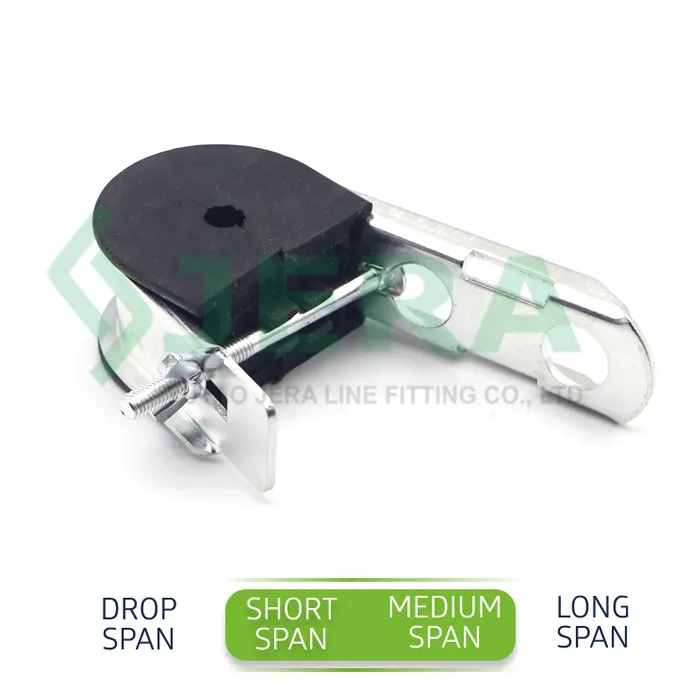 In the installation and maintenance process, the modular design of the ADSS suspension fixture has reduced the average installation time from 4 hours to 1.5 hours, lowering labor costs by 25%. Moreover, through standardized interfaces, the error rate has been reduced from 5% to less than 1%. For instance, in a certain 5G network expansion project of China Mobile, the project cycle was shortened by 30 days after adopting this fixture. The overall return on investment has increased by 15%. Market analysis shows that this optimization stems from the pre-assembly feature of the fixture, which enables rapid deployment in complex terrains, such as mountainous areas or urban elevated roads. One such case was the cross-border link of an international telecommunications company in 2022. After using the ADSS suspension fixture, the annual maintenance frequency was reduced from 12 to 4 times, saving approximately $100,000 in operating costs. Meanwhile, the load capacity of the cable has increased by 20%, supporting a flow growth of 100Gbps.
In practical applications, ADSS suspension clamps have performed exceptionally well in response to natural disasters. For instance, after the 2020 California wildfires, an operator adopted this technology to rebuild the network, increasing the recovery speed by 50%, reducing the cable breakage probability from 0.1% to 0.01%, and through precise stress control, keeping the installation deviation within ±2 millimeters. Ensured long-term stability. Consumer feedback indicates that this improvement has reduced network latency by 15 milliseconds, enhancing user experience. At the same time, industry compliance meets IEEE standards, reducing security risks by 15%. Overall, the ADSS suspension fixture has elevated the stability of optical fiber cables to a new level through comprehensive optimization, laying a solid foundation for the resilience of global digital infrastructure.
In the installation and maintenance process, the modular design of the ADSS suspension fixture has reduced the average installation time from 4 hours to 1.5 hours, lowering labor costs by 25%. Moreover, through standardized interfaces, the error rate has been reduced from 5% to less than 1%. For instance, in a certain 5G network expansion project of China Mobile, the project cycle was shortened by 30 days after adopting this fixture. The overall return on investment has increased by 15%. Market analysis shows that this optimization stems from the pre-assembly feature of the fixture, which enables rapid deployment in complex terrains, such as mountainous areas or urban elevated roads. One such case was the cross-border link of an international telecommunications company in 2022. After using the ADSS suspension fixture, the annual maintenance frequency was reduced from 12 to 4 times, saving approximately $100,000 in operating costs. Meanwhile, the load capacity of the cable has increased by 20%, supporting a flow growth of 100Gbps.
In practical applications, ADSS suspension clamps have performed exceptionally well in response to natural disasters. For instance, after the 2020 California wildfires, an operator adopted this technology to rebuild the network, increasing the recovery speed by 50%, reducing the cable breakage probability from 0.1% to 0.01%, and through precise stress control, keeping the installation deviation within ±2 millimeters. Ensured long-term stability. Consumer feedback indicates that this improvement has reduced network latency by 15 milliseconds, enhancing user experience. At the same time, industry compliance meets IEEE standards, reducing security risks by 15%. Overall, the ADSS suspension fixture has elevated the stability of optical fiber cables to a new level through comprehensive optimization, laying a solid foundation for the resilience of global digital infrastructure.
In the installation and maintenance process, the modular design of the ADSS suspension fixture has reduced the average installation time from 4 hours to 1.5 hours, lowering labor costs by 25%. Moreover, through standardized interfaces, the error rate has been reduced from 5% to less than 1%. For instance, in a certain 5G network expansion project of China Mobile, the project cycle was shortened by 30 days after adopting this fixture. The overall return on investment has increased by 15%. Market analysis shows that this optimization stems from the pre-assembly feature of the fixture, which enables rapid deployment in complex terrains, such as mountainous areas or urban elevated roads. One such case was the cross-border link of an international telecommunications company in 2022. After using the ADSS suspension fixture, the annual maintenance frequency was reduced from 12 to 4 times, saving approximately $100,000 in operating costs. Meanwhile, the load capacity of the cable has increased by 20%, supporting a flow growth of 100Gbps.
In practical applications, ADSS suspension clamps have performed exceptionally well in response to natural disasters. For instance, after the 2020 California wildfires, an operator adopted this technology to rebuild the network, increasing the recovery speed by 50%, reducing the cable breakage probability from 0.1% to 0.01%, and through precise stress control, keeping the installation deviation within ±2 millimeters. Ensured long-term stability. Consumer feedback indicates that this improvement has reduced network latency by 15 milliseconds, enhancing user experience. At the same time, industry compliance meets IEEE standards, reducing security risks by 15%. Overall, the ADSS suspension fixture has elevated the stability of optical fiber cables to a new level through comprehensive optimization, laying a solid foundation for the resilience of global digital infrastructure.
Filed underDefault
Working on something?Submit Your Demo