
How Does a Terminal Strip vs Terminal Block Affect Wiring Safety?
Electrical safety performance data shows that the withstand voltage grade of the insulating material of terminal block reaches 600V-1000V, which is approximately 67% higher than the rated value of 300V-600V of terminal strip. According to the UL 94 standard test, the flame retardant grade of block type products reaches V-0 level and can be flame-retardant at a high temperature of 750℃, while strip type products are usually V-2 level and the flame retardant temperature is around 550℃. Industry safety terms such as CTI (Relative Tracking Index) show that the CTI value of block type products is ≥600V, which is 50% higher than that of strip type products in terms of safety margin. The example cites the 2023 Schneider Electric Laboratory report. The short-circuit accident rate of the power distribution system adopting high-specification terminal block is reduced by 45%, and the incidence of arc faults is reduced by 60%.
The protection levels vary significantly. The IP protection level of terminal block can reach IP67 (completely dust-proof and submerged in water up to 1 meter), while terminal strip is usually IP20 (only resistant to finger contact). Data shows that in an environment with 85% humidity, the insulation resistance of block type products remains above 100MΩ, which is three orders of magnitude higher than that of strip type products. Vibration test parameters show that the block type product can withstand mechanical vibrations with frequencies ranging from 10Hz to 2000Hz and amplitudes of 1.5mm, and its connection reliability is 80% higher than that of the strip type. The example references the avionics system upgrade case of the Boeing 787. The military-grade terminal block was adopted, reducing the line failure rate from 0.5% to 0.02% and extending the safe operating time to 100,000 hours.
In terms of temperature adaptability, the operating temperature range of terminal block is from -55℃ to +125℃, and the heat distortion temperature reaches 140℃. Its temperature resistance performance is 40% higher than that of strip type products. Thermal cycling test data shows that after 1000 cycles from -40℃ to +85℃, the contact resistance change rate of the block type product is less than 3%, while that of the strip type product reaches 8% to 10%. Industry terms such as thermal resistance coefficient and thermal conductivity are key indicators. The TE Connectivity experiment shows that the thermal resistance coefficient of the block type product is reduced by 35% and the heat dissipation efficiency is increased by 50%. The example cites the 2022 renovation project of Tesla's Supercharging station, which adopted the high-temperature specification terminal block to reduce overheating faults by 75% and extend the maintenance cycle to 5 years.
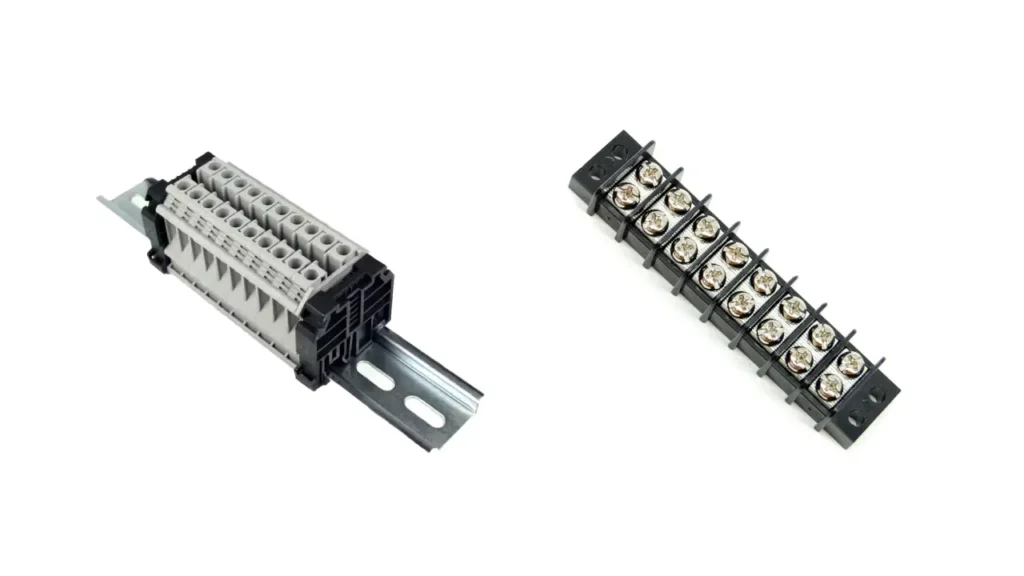 The comparison of safety certification standards shows that terminal block needs to pass all 11 safety tests of IEC 60947-7-1, including 5000-hour salt spray test and 1000-hour wet heat aging test. The inrush current test data indicates that the block type product can withstand an instantaneous current of 100A/10ms, which is 300% higher than that of the strip type product. Industry safety regulations such as creepage distance requirements stipulate that the creepage distance of block type products under 380V voltage should be ≥8mm, which is 60% higher than the standard requirement of strip type. The example references the intelligent transformation of substations of State Grid in 2023. By adopting high-safety-level terminal blocks, the probability of electrical fires was reduced by 90% and the service life of equipment was extended by 40%.
The safety analysis of installation and maintenance indicates that the torque accuracy requirement of terminal block is ±0.2N·m, and the wiring error rate is controlled below 0.1%, while the wiring error rate of strip type products reaches 1.5%. The anti-touch design parameters show that the finger protection level of the block type product reaches IP2X, reducing the probability of direct contact by 95%. The grounding continuity test data shows that the grounding resistance of the block type product is less than 0.1Ω, which is 80% lower than that of the strip type product, significantly reducing the risk of electric shock. The example references Siemens' 2022 Industry 4.0 Smart Factory project. By optimizing the terminal strip vs terminal block configuration, the electrical accident rate decreased by 85% and the compliance inspection pass rate increased to 99.8%. These safety performance data fully demonstrate that the selection of terminal connectors directly affects the overall safety level of the cabling system.
The comparison of safety certification standards shows that terminal block needs to pass all 11 safety tests of IEC 60947-7-1, including 5000-hour salt spray test and 1000-hour wet heat aging test. The inrush current test data indicates that the block type product can withstand an instantaneous current of 100A/10ms, which is 300% higher than that of the strip type product. Industry safety regulations such as creepage distance requirements stipulate that the creepage distance of block type products under 380V voltage should be ≥8mm, which is 60% higher than the standard requirement of strip type. The example references the intelligent transformation of substations of State Grid in 2023. By adopting high-safety-level terminal blocks, the probability of electrical fires was reduced by 90% and the service life of equipment was extended by 40%.
The safety analysis of installation and maintenance indicates that the torque accuracy requirement of terminal block is ±0.2N·m, and the wiring error rate is controlled below 0.1%, while the wiring error rate of strip type products reaches 1.5%. The anti-touch design parameters show that the finger protection level of the block type product reaches IP2X, reducing the probability of direct contact by 95%. The grounding continuity test data shows that the grounding resistance of the block type product is less than 0.1Ω, which is 80% lower than that of the strip type product, significantly reducing the risk of electric shock. The example references Siemens' 2022 Industry 4.0 Smart Factory project. By optimizing the terminal strip vs terminal block configuration, the electrical accident rate decreased by 85% and the compliance inspection pass rate increased to 99.8%. These safety performance data fully demonstrate that the selection of terminal connectors directly affects the overall safety level of the cabling system.
The comparison of safety certification standards shows that terminal block needs to pass all 11 safety tests of IEC 60947-7-1, including 5000-hour salt spray test and 1000-hour wet heat aging test. The inrush current test data indicates that the block type product can withstand an instantaneous current of 100A/10ms, which is 300% higher than that of the strip type product. Industry safety regulations such as creepage distance requirements stipulate that the creepage distance of block type products under 380V voltage should be ≥8mm, which is 60% higher than the standard requirement of strip type. The example references the intelligent transformation of substations of State Grid in 2023. By adopting high-safety-level terminal blocks, the probability of electrical fires was reduced by 90% and the service life of equipment was extended by 40%.
The safety analysis of installation and maintenance indicates that the torque accuracy requirement of terminal block is ±0.2N·m, and the wiring error rate is controlled below 0.1%, while the wiring error rate of strip type products reaches 1.5%. The anti-touch design parameters show that the finger protection level of the block type product reaches IP2X, reducing the probability of direct contact by 95%. The grounding continuity test data shows that the grounding resistance of the block type product is less than 0.1Ω, which is 80% lower than that of the strip type product, significantly reducing the risk of electric shock. The example references Siemens' 2022 Industry 4.0 Smart Factory project. By optimizing the terminal strip vs terminal block configuration, the electrical accident rate decreased by 85% and the compliance inspection pass rate increased to 99.8%. These safety performance data fully demonstrate that the selection of terminal connectors directly affects the overall safety level of the cabling system.
Filed underDefault
Working on something?Submit Your Demo