
One-Time, Two-Time and Finger-Joint: Reading the Press Grade
Press grade is the least glamorous line on a shuttering panel datasheet and the one that decides how many times the panel comes off the wall intact. Dongstar publishes three grades — one-time hot press, two-time hot press and finger-joint — alongside a certification set of ISO, CE, CARB and FSC, with thicknesses of 9 to 24 mm at a ±0.5 mm tolerance, as stated on the manufacturer's own pages, read 29 Sept 2026.

Key takeaways
- Three press grades are published: one-time hot press, two-time hot press and finger-joint construction.
- The finger-joint grade carries its own thickness list of 8, 10, 12, 15 and 18 mm.
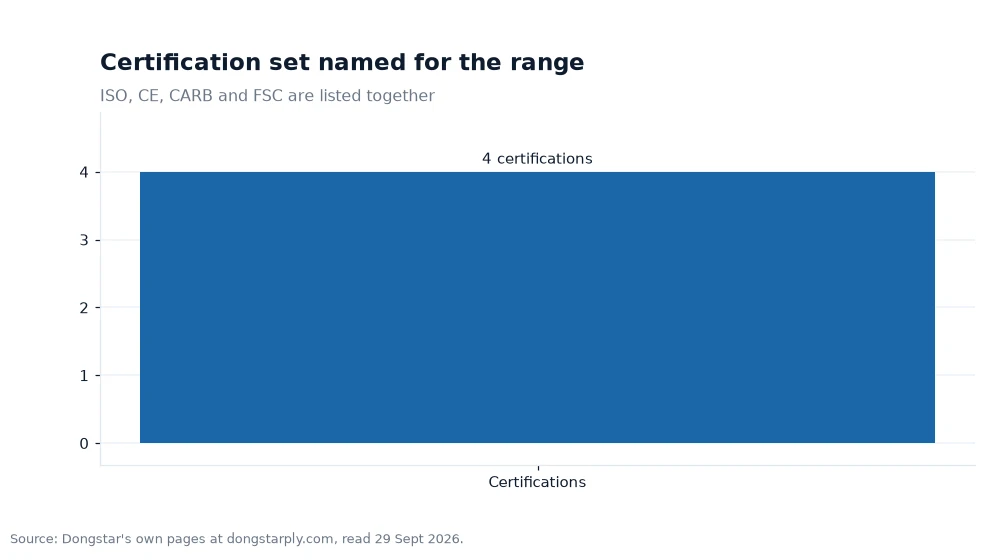
- Certification across the range is published as ISO, CE, CARB and FSC — four documents, four different questions.
- Waterproof edge sealing is a published option and is described as extending the working life of a panel.
What a press cycle does to a panel
A hot press applies heat and pressure to a stack of glued veneers until the resin cures. The number of times a panel is taken through that cycle is a structural fact about the panel, not marketing language. A one-time pressed board passes through once, which is the economical route and the right one for work where the panel faces a limited number of pours. A two-time pressed board is put through a second cycle, and the published grade list separates it from the single-press product for exactly that reason.
Why the second cycle matters is worth stating plainly. Resin cure and internal bond depend on time, temperature and pressure being delivered evenly through the whole stack. A second pass adds consolidation and reduces the chance of a dry or under-cured patch sitting inside the board, which is the kind of defect that does not show at delivery and does appear as edge swelling or delamination six weeks later. Buyers who have been burned by a panel that failed early tend to specify the heavier grade on the next order, and the grade list gives them the vocabulary to do it. On a Film Faced Plywood specification the grade line is read before the price line, not after it.
Finger-joint: a grade, not a species
Finger-joint sits in the same published list as the two press grades, which is the source of a frequent misunderstanding. It describes how the core is assembled: shorter lengths of timber are profiled and joined end to end instead of using continuous veneer sheets for the full panel. The published description credits that construction with good strength and stability, resistance to warping and cracking, and use in higher-grade plywood where structural integrity is required.
Because it is an assembly method, finger-joint carries its own thickness list — 8, 10, 12, 15 and 18 mm — that does not match the 9 to 24 mm band of the main range. A buyer who needs an 8 mm structural panel has a published option; a buyer who needs a 24 mm finger-joint panel is asking for something outside the list and should expect the answer to be a custom line or a different grade entirely.
Glue line: WBP melamine against WBP phenolic
The two resin systems published for this range are WBP melamine and WBP phenolic, and they are not interchangeable. WBP melamine is described as resistant to water and weather and recommended for outdoor and marine conditions, concrete formwork and flooring. WBP phenolic is described as resistant to water, heat and chemicals, suitable for indoor and outdoor use, for load-bearing work and for extreme conditions. Both are made to strict quality standards, which is a statement about process rather than a ranking. Panels in this range are made by Dongstar Group at its base in Linyi city, Shandong province, China.
In practice, the choice follows the exposure. A panel that faces concrete and is then washed down sits in a wet, alkaline environment where water resistance in the glue line is doing most of the work. A panel used in an industrial setting where heat or chemical contact is part of the process needs the second property as well. Because both glues are published under the same WBP prefix, it is worth writing the resin name into the order rather than the abbreviation alone.
Certificates answer four separate questions
The certification list reads ISO, CE, CARB and FSC, and reading it as a single badge is the most common mistake buyers make. The CE document is the one a European contractor needs before a panel goes into a structure. CARB relates to formaldehyde release for interior products sold into North America. FSC is a chain-of-custody statement about where the fibre came from. ISO is a management-system certificate covering how the organisation runs, not what a particular board tested at.
Because the four certificates cover four different risks, they should be requested product by product. A formwork buyer will care most about the CE document and about any inspection reports attached to the order. A buyer sourcing panels that will end up inside a house will care about the formaldehyde classification. Asking which of the four applies to the exact board being quoted takes one email and prevents the situation where a certificate exists but does not cover the delivery.
Films, edges, sizes and the tolerance figure
The face and back options published for this range run through Dynea dark brown film, black film, brown film, plastic film and anti-slip film. The notes attached to them are specific rather than decorative. Black film is said to offer strong contrast across a uniform surface, and to stand up to water, chemicals and abrasion; brown film is put forward as the durable, cost-effective choice for construction work; and Anti Slip film is the option commonly found in workshops, where it stops vehicles sliding on the panel surface.
Waterproof edge sealing is published as an option, and the manufacturer's own description gives the reason: it keeps moisture out of the cut edges and protects them from damage, which extends the life of a formwork panel. An unsealed edge is where most water damage starts, because the film protects the faces but stops at the perimeter. For a panel that will be re-used, sealing is one of the least expensive decisions on the sheet.
Sheet formats come in three published sizes — 1220 × 2440 mm, 1250 × 2500 mm and 900 × 2100 mm — with custom sizes on request. Thickness runs at 9 mm through 12, 15, 18 and 21 mm up to 24 mm, or on request, with a tolerance of ±0.5 mm. That last figure deserves attention at the order stage. Across a stack of panels, a mill working at one end of the band and a mill working at the other will not produce the same assembled formwork height, and the difference shows up as shimming on site rather than as a defect on paper.
| Published field | Values listed | Why it is checked |
|---|---|---|
| Press grade | One-time hot press, two-time hot press | How many pours a panel is expected to take |
| Finger-joint | 8, 10, 12, 15, 18 mm | Structural integrity where continuous veneer is unsuitable |
| Glue line | WBP melamine; WBP phenolic | Weather, heat and chemical exposure |
| Certification | ISO, CE, CARB, FSC | Access to European and North American project work |
| Edge treatment | Waterproof edge sealing available | Panel life and moisture ingress at the perimeter |
Worked example: how many pours before a grade pays for itself
Assume a site faces 1,500 m² of concrete and compares two specifications. In the 1220 × 2440 mm format, one sheet converts to 2.98 m² (example), so one pass needs 1,500 ÷ 2.98 = 504 sheets, rounded up (example). If the heavier grade survives three pours instead of two, the same 1,500 m² needs 504 ÷ 3 = 168 sheets per cycle against 504 ÷ 2 = 252 sheets (example) — a difference of 84 sheets on the same job.
The arithmetic only holds if the panels are actually re-usable. Two conditions have to be met for that: the edges must be sealed, since unsealed edges are where moisture damage begins, and the panels must be stripped and stacked with the faces protected rather than dragged across a slab. Where those conditions hold, the grade premium is easier to justify. Where they do not, a heavier grade simply becomes an expensive single-use panel, and the cheaper specification is the honest choice.
Frequently asked questions
Is a two-time hot press panel twice as strong?
No. The published grade list simply distinguishes one-time hot press, two-time hot press and finger-joint construction. The second press cycle consolidates the glue line, and buyers read that as better resistance to early edge damage rather than as a doubling of any single property.
What glue should a panel face for outdoor work be specified with?
WBP melamine is the resin the manufacturer recommends for outdoor and marine conditions and for concrete formwork, while WBP phenolic is described as suitable for both indoor and outdoor use where heat, chemicals and load are involved.
Do the four certificates apply to every board in the range?
They are published across the range, but they answer different questions — CE for placement in European structures, CARB for formaldehyde release, FSC for fibre origin and ISO for management systems — so the applicable document should be confirmed for the specific product quoted.
Reading the grade before the price
Anyone comparing panel specifications will find it useful to start with the formwork beam page, because beams and panels are specified together on most sites, and then to look across the whole panel range to see how the grades sit alongside the other product families. A grade that is named in the order is a grade a mill can be held to.
Grade definitions, resin types and certification entries cited above are drawn from the supplier's own site, consulted on 29 Sept 2026, and taken for these notes, as the basis for these notes[1].